
The Cost of Fuel and the Cost of Borrowing Money Both Just Went Up in South Africa
As fuel tax relief expired and interest rates rose, consumers were left absorbing both shocks at once.
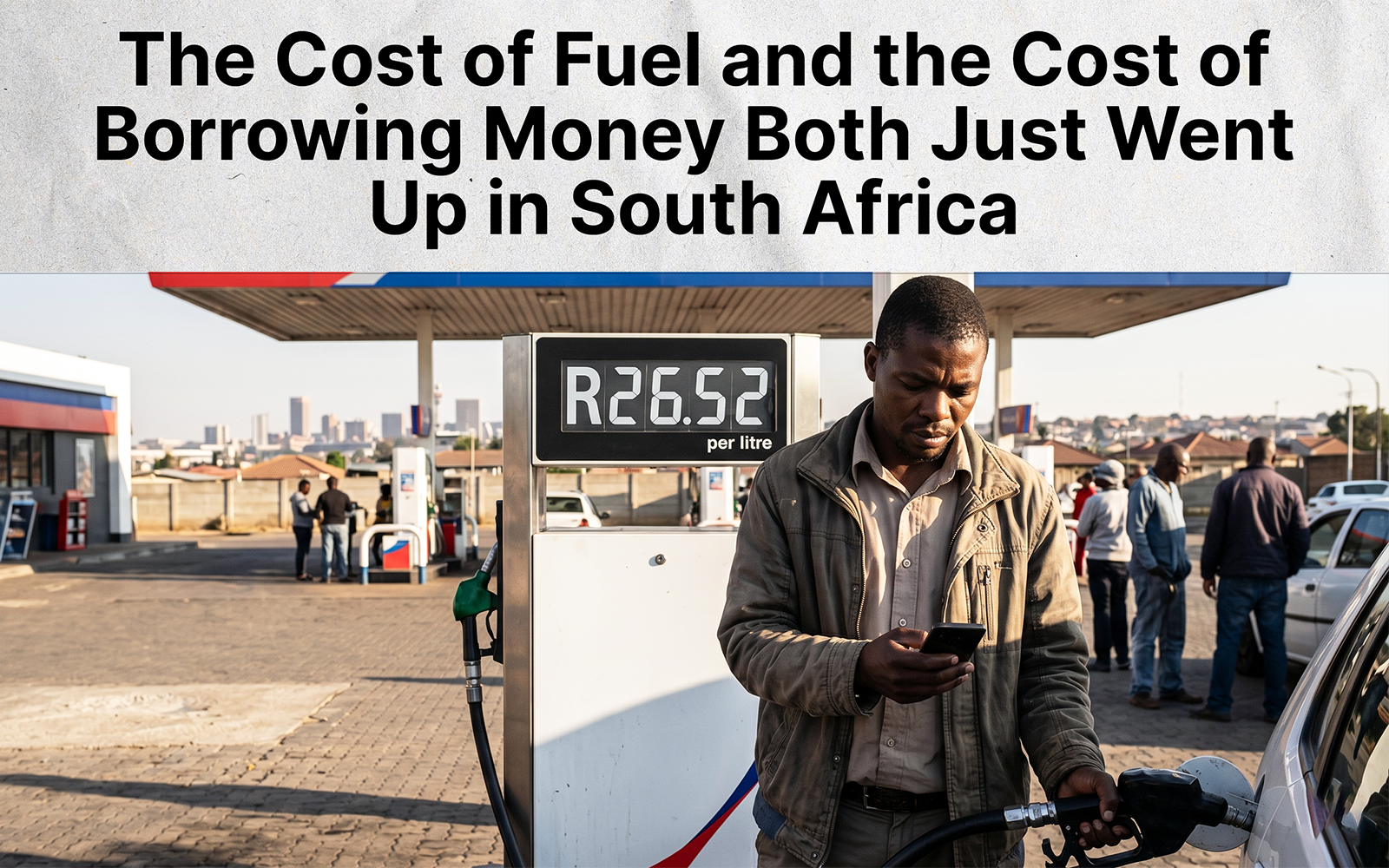
On June 3, 2026, South Africa did two things at once: it made money more expensive and fuel more expensive. The South African Reserve Bank’s Monetary Policy Committee voted on May 28 to raise the repo rate by 25 basis points to 7 percent, lifting the prime lending rate — the rate at which commercial banks lend to households and businesses — to 10.50 percent. On the same day, the National Treasury began phasing out the emergency fuel levy relief it had put in place two months earlier, restoring R1.50 per litre of petrol tax and R1.97 per litre of diesel tax with immediate effect. Two policy decisions, one day. The household absorbs both.
Neither decision was made in a vacuum. The fuel shock began in late February, when escalating conflict in the Middle East sent Brent crude above $115 per barrel following the disruption of the Strait of Hormuz — the same geopolitical chain that pushed Ethiopian fuel prices from under 100 Birr per litre in early 2025 to 167 Birr per litre by May 2026. Both countries import their oil. Both countries’ currencies weakened as dollar-denominated import costs surged. The difference is what each government chose to do about it. South Africa introduced a temporary emergency tax cut of R3.00 per litre on petrol and R3.93 per litre on diesel in April and May to cushion the blow. Ethiopia, whose government had already spent 72 billion Birr on fuel subsidies before the global shock hit, continued to absorb costs directly while simultaneously raising prices at the pump every quarter. The emergency is the same. The tools available to manage it are not.
To understand what the South African numbers mean, it helps to translate them. South Africa’s national minimum wage as of March 2026 is R30.23 per hour, or approximately R4,974 per month for a standard 38-hour week. Petrol 93 now costs R26.52 per litre at the pump — meaning a minimum-wage worker in Johannesburg pays the equivalent of roughly 53 minutes of labour for a single litre of fuel. In Addis Ababa, petrol costs 167 Birr per litre. The average daily wage for an informal sector worker in Addis is estimated at 250–350 Birr — meaning a litre of fuel represents between 48 and 67 minutes of work. On this measure, the pump is punishing workers at roughly the same rate on both sides of the continent, despite a gap of more than R25,000 in average monthly incomes between the two countries. The burden is proportional. The capacity to absorb it is not.
The interest rate decision compounds this directly. The MPC’s vote was not unanimous — four members backed the hike, two preferred to hold, reflecting a genuine internal debate about whether the inflation risk from fuel justified tightening credit conditions for households already under pressure. The committee concluded that it did, citing the risk of second-round inflationary effects — the mechanism by which a fuel price rise feeds into transport costs, then food prices, then wage demands, then a broader price spiral. Ethiopia’s parallel: the National Bank of Ethiopia has maintained a high lending rate environment since the Birr was floated in July 2024, with the devaluation itself triggering the food inflation that hit 13.5 percent in April 2026. The second-round effect the South African MPC feared has already arrived in Ethiopia. The policy instrument differs; the economic consequence is structurally identical.
The more consequential number in the South African story is not June’s — it is July’s. National Treasury has confirmed that the remaining 50 percent of the emergency fuel levy relief will expire on July 1, 2026, returning the general fuel levy to its baseline of R4.10 per litre for petrol. Unless Brent crude falls sharply through June, South African motorists face a third consecutive month of pump price increases — each one layered on top of an interest rate that is now 25 basis points higher than it was a week ago. A middle-income household running two cars can expect its monthly fuel bill to rise by approximately R1,500 from where it stood at the start of the year, in an environment where salary increases are running at 4 to 5 percent annually. The real income compression is not a projection. It is already in motion.
What South Africa’s June 3 announcement illustrates, for any African economy watching, is the finite shelf life of a subsidy. Governments can absorb an oil shock temporarily — South Africa’s Treasury cut R3.00 per litre for two months; Ethiopia’s government spent 72 billion Birr over several years — but the deferred cost does not disappear. It surfaces either at the pump, through tax restoration, or in the inflation figures, through the second-round effects, and the central bank then has to raise rates to contain. The consumer pays either way. The only variable is the timing. In January 1976, petrol in South Africa cost 21.1 cents per litre. By May 2026, it cost R26.52 — an increase of 12,470 percent in fifty years. The lesson for Nairobi, Lagos, Addis Ababa, and every capital city managing a fuel import bill against a weakening currency is that the structural problem does not resolve at the pump. It resolves, if it resolves at all, in the energy mix. Until then, the shock absorbers are temporary and the consumer is last in line.