
What Is FaydaVerse? The Ethiopian National ID Program That Became a Company — And How It Plans to Make Money.
Ethiopia spun its 50-million-user Fayda identity system into a state-owned company on August 4, 2026, with four revenue lines and MoUs in twelve African countries.

FaydaVerse began operating on August 4, 2026, taking over management of Ethiopia's national identity system. The entity is a state-owned enterprise under Ethiopian Investment Holdings. Its board is chaired by the Minister for Cabinet Affairs, and its authorized capital is set at 10 billion Birr, about $64 million at current exchange rates.
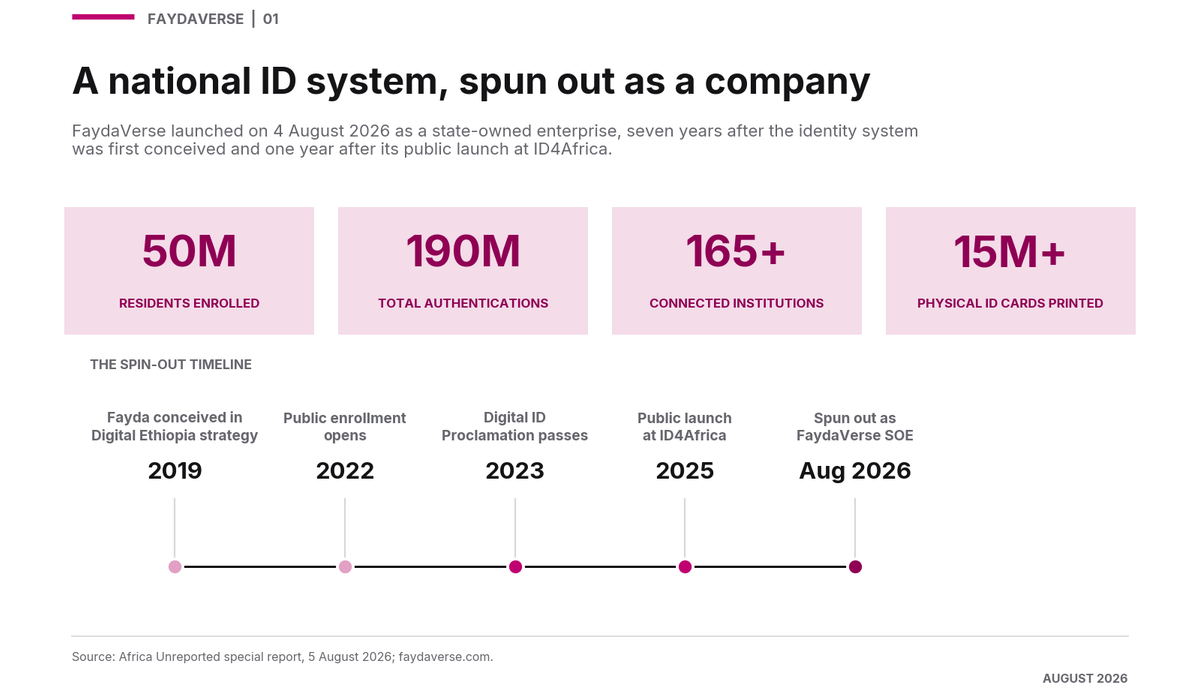
The company inherits the Fayda Digital ID system, which has processed 190 million secure authentications, connected more than 165 public and private institutions, issued over 15 million physical ID cards, and deployed more than 12,000 registration kits across the country.
Fayda originated in 2019 as part of Ethiopia's Digital Ethiopia strategy. Enrollment began in 2022. The Digital Identification Proclamation passed the House of Peoples' Representatives in March 2023. The system launched publicly at the ID4Africa conference in Addis Ababa in February 2025, using TECH5's biometric matching technology and certified against W3C and EU eIDAS interoperability standards.
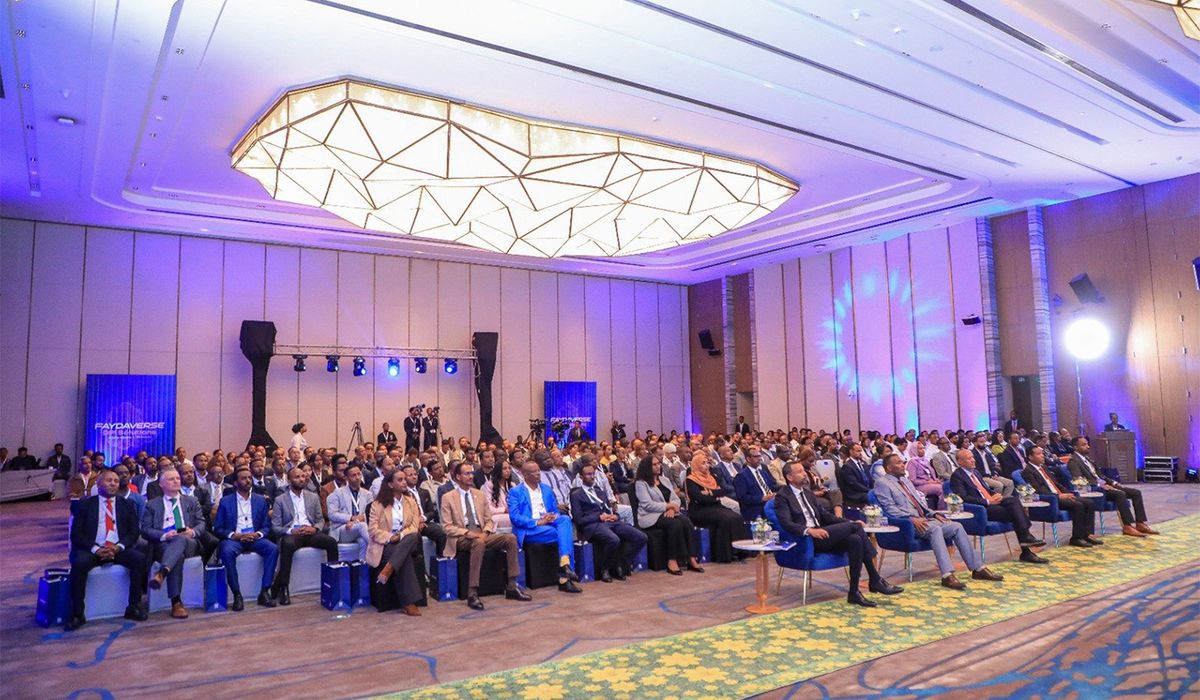
The August 4 change established FaydaVerse as a formal enterprise with its own balance sheet, board, and commercial mandate, separate from the government body that previously ran the program.
FaydaVerse organises its business around four product lines, each designed, according to the company's own site, for partnership through joint ventures rather than a fully in-house build. Fayda ID covers population-scale enrollment, card printing and delivery, and real-time biometric eKYC — the verification layer banks and telecoms already depend on. Fayda Wallet is a digital credential vault handling single sign-on, access control, and payments across government-to-person, person-to-person, and person-to-merchant transactions. Fayda E-Services manages e-government platforms spanning commerce, social protection, agriculture, tax, and trade, turning a static ID number into a login for public services.
Fayda Enterprise Solutions is the least visible and, on paper, the most lucrative of the four: DPI security consulting, managed hardware security modules, cryptographic sovereignty work, systems integration, and what the company calls Talent-as-a-Service — contracting out the engineers who built Fayda to other governments. At the launch event, the company added detail to that stack: e-KYC, OTP verification, Face ID, and a new consumer product, Fayda Pass, a wallet for storing ID documents, educational credentials, and other certificates in one place.
FaydaVerse's published revenue architecture rests on four fee lines. The first is authentication and eKYC fees: every time a bank, telecom, hospital, or government office checks a citizen's identity against the Fayda database, FaydaVerse charges for the lookup. The second is e-services convenience fees, a transaction charge layered onto bill payments, tax filings, and licence renewals processed through the platform. The third is credential issuance — the physical ID card currently costs 350 Birr to produce and is expected to fall toward 150 Birr as volume procurement kicks in. The fourth, and the one with no domestic ceiling, is enterprise ERP and systems-integration work sold to other governments. More than 150 enterprises already pay for eKYC integration inside Ethiopia, and the platform is now handling upward of two million verifications a day — that daily volume is the base the other three fee lines compound against.
FaydaVerse says it will build most of this through joint ventures rather than a fully state-funded rollout, a structure the company frames as a shift away from traditional donor dependence. The stated philosophy has three more legs: open technology to avoid vendor lock-in — Fayda runs on the Modular Open Source Identity Platform, MOSIP, the same framework Zambia is now sourcing integrators for — local talent development through structured training and the Talent-as-a-Service line, and a partner list spanning investors, governments, systems integrators, development partners, banks, and research organisations. The pitch to each of those partners is consistent: Ethiopia has already paid the fixed cost of building a population-scale identity system, tested it at fifty million users, and connected it to banks, telecoms, and tax authorities. What it is selling now is the marginal cost of doing that again elsewhere, which runs lower than building from zero.
FaydaVerse has signed MoUs with twelve African counterparts, with active paying contracts so far limited to Ethiopia and Zambia and earlier-stage engagements in Burundi, South Sudan, Malawi, Nigeria, the DRC, Mozambique, Senegal, Liberia, Gabon, Burkina Faso, São Tomé, and Niger. Zambia is the most advanced case. Its Smart Zambia Institute agreed in late 2025 to co-design a digital identity system with Ethiopia's National ID Program under a South-South cooperation framework, with both countries' rollouts financed in parallel by the World Bank. By March 2026, Zambia was recruiting its own MOSIP systems integrator to execute the build, tying its digital-ID push to a separately stated $60 billion 2031 digital-transformation target. Mozambique signed a three-year cooperation agreement in April 2026, pairing FaydaVerse with the country's Agency for Digital Transformation and Innovation during a state visit by President Daniel Chapo.
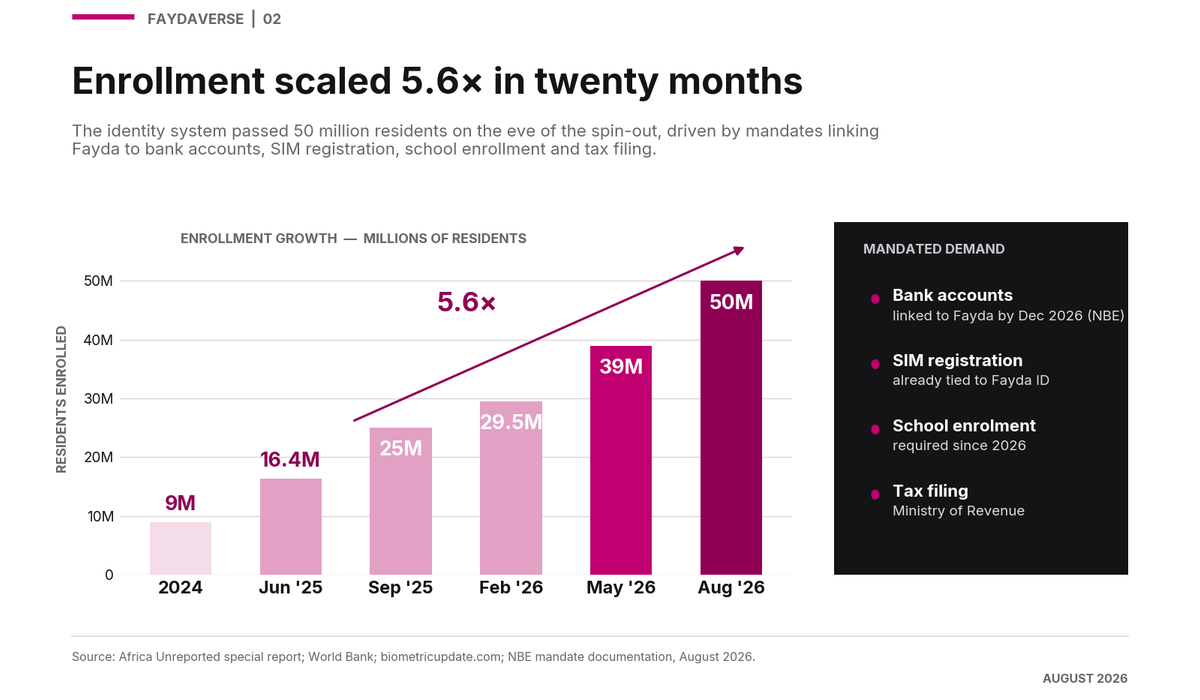
Fayda's enrollment curve is the fastest-growing part of the story and the hardest to pin to one target date. Registration stood at roughly 9 million by 2024, 16.4 million in June 2025, and had passed 25 million by September 2025 — 91 percent of that year's World Bank-monitored target. It reached 29.5 million in February 2026 and more than 39 million by May, with 78 million authentications and over 100 connected institutions recorded at that point. By July 27, Ethio Telecom alone had enrolled 32 million people — 69 percent of everyone registered — pushing the national total past 47.8 million days before the FaydaVerse launch put it at nearly 50 million.
The $350 million World Bank-financed Digital ID for Inclusion and Services project underwrites the enrollment side through 2030, and roughly 55 billion Birr of that financing recently went toward a Super Agent procurement aimed at reaching underserved rural communities. The 90-million target all of this is chasing has itself moved: official documents have cited 2027, 2028, and 2030 for reaching it, and FaydaVerse's own launch materials now put the deadline at the end of 2026.
The National Bank of Ethiopia has mandated that every bank account be linked to a Fayda ID by December 2026, SIM cards are already tied to it, school registration has required it since this year, and the Ministry of Revenue uses it for tax filing — each mandate is a forced customer for the authentication fee line.
India's Aadhaar is the reference point FaydaVerse is implicitly building toward: more than 1.4 billion people enrolled, roughly 80 million authentications a day, and $2.2 trillion in UPI transactions processed by its payments layer, the NPCI, in 2025. FaydaVerse is at fifty million users and 190 million total authentications — not per day, total. The distance is best read against Aadhaar in 2012, three years after its own launch, when enrollment stood at 200 million and its authentication system was still new. Ethiopia sits roughly at that stage now: a smaller population, a younger programme, and, as of August 4, a government that has formally handed the infrastructure to a commercial entity with orders to grow it.
None of FaydaVerse's revenue math works without the underlying trust that citizens will keep enrolling and keep consenting to be checked against the database. Ethiopia's Digital Identification Proclamation bars Fayda from collecting ethnicity, blood group, DNA, religious belief, health records, or criminal history, requires signed consent before registration, and sets penalties of up to eight years in prison for unauthorised disclosure. The Personal Data Protection Proclamation, in force since July 2024, adds a data-sovereignty requirement that personal data collected in Ethiopia be stored domestically.
FaydaVerse sits inside Ethiopian Investment Holdings, Africa's largest sovereign wealth fund, which manages close to $45 billion in assets across roughly 40 state enterprises including Ethiopian Airlines and Ethio Telecom. Set against that portfolio, FaydaVerse's 10 billion Birr authorised capital is a small opening position — Ethiopian Electric Power alone, folded into EIH in 2024, carries 709 billion Birr in assets on its own. EIH's chief executive, Dr Brook Taye, has said the goal is to let FaydaVerse “scale sustainably, attract partnerships, and create long-term value for Ethiopia” — the kind of institutional backing a five-year-old government programme could not offer on its own.
FaydaVerse has the enrollment numbers, the mandate-driven demand, and now the corporate structure to bill for all of it.