
From a 12-Hour Drive to a 1-Hour Flight: Ethiopia Opens Up Remote Border Region with New Airport
Ethiopian Airlines lands in Negelle Borena — a town most people have never heard of, in a region bigger than Switzerland, sitting on one of Africa’s largest pastoral economies.
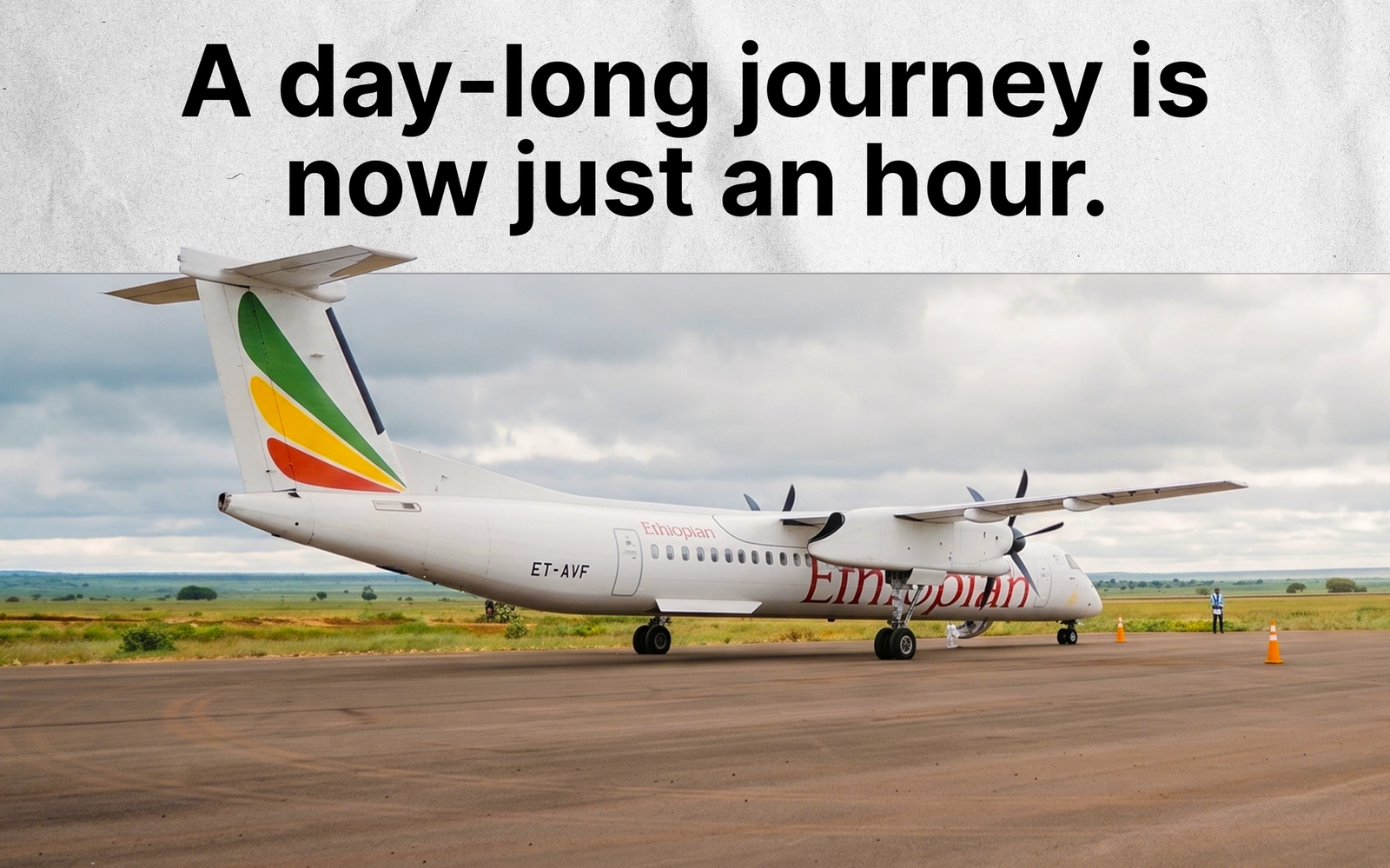
Picture a town of roughly 73,000 people sitting at the end of a single road that runs 610 kilometres south from the capital, about the same driving distance as London to Edinburgh, or New York to Boston and back. The road winds down from the Ethiopian highlands into open savanna, crosses into territory that shares a border with Kenya, and ends at Negelle Borena: the largest settlement of the Borana Oromo, a pastoral people who have governed the use of land, water, and livestock in this region for centuries through a governance system called the gadaa. Until 27 May 2026, if you needed to get from Negelle to Addis Ababa in a hurry, the road was your only option. It takes twelve hours on a good day.
The territory around Negelle is not small. The Borena zone covers more than 45,000 square kilometres — larger than Switzerland, larger than Denmark, larger than the state of Maryland and Delaware combined. Most of it is semi-arid savanna and communal grazing land, and most of its value is on four legs. The zone holds approximately 1.6 million cattle, 2 million sheep and goats, and 700,000 camels — a livestock population that rivals the national herds of several European countries. That is not subsistence farming. That is one of Africa’s major pastoral economies, moving beef and livestock along ancient trade routes south through Moyale into northern Kenya and eventually to terminal markets in Nairobi, where Borena cattle fetch prices high enough to support an entire cross-border credit and brokerage network. A single Borana National Park in the zone covers 45,366 km² — bigger than the Netherlands. The wildlife sanctuary at Yabello, Negelle’s neighbouring town that already received its own airport in 2025, covers another 2,500 km². This is a region of enormous ecological and economic scale that has, until now, had the transport infrastructure of a small village.
On 27 May 2026, Ethiopian Airlines inaugurated Negelle Borena Geda Airport as its 24th domestic destination, with three weekly flights operated by Boeing 737 MAX aircraft. The 737 MAX is not a small plane: it carries up to 230 passengers and is capable of moving cargo on shorter routes. The flight time from Negelle to Addis Ababa is under two hours. The drive is twelve. That arithmetic — ten hours saved each way, on a route that traders, officials, medical patients, and business people travel constantly — is the economic story of the airport in its most compressed form.
The airline opening this service is worth understanding in full, because it reframes what a domestic route to a pastoral town actually means. Ethiopian Airlines marked its 80th anniversary on 8 April 2026, having grown from five ex-military aircraft on a single route to Cairo into Africa’s largest carrier by every standard measure: fleet, destinations, revenue, and passengers. Over the past eight years, passenger numbers have grown 80 percent, cargo 97 percent, revenue 120 percent, and profit threefold. The airline now carries more than 20 million passengers a year, operates 147 aircraft to 145 international destinations on five continents, and posted $7.6 billion in revenue in its 2024–2025 fiscal year. In May 2026, it was ranked the fastest-growing airline in the world. This is not a regional carrier doing a favour for a remote town. This is a global airline building a continental architecture, and Negelle Borena is a deliberate node in it.
Negelle is the third of three airports announced simultaneously in February 2026 alongside Gore Metu in the southwest and Debre Markos in the northwest, with Mizan Aman still to follow. CEO Mesfin Tasew said the additions would take the domestic network from 23 to 27 destinations. Look at where those new airports are: Gore Metu borders the forested southwest near South Sudan. Debre Markos anchors the Amhara highlands. Mizan Aman sits at the edge of the Bench-Sheko zone. Yabello and Negelle cover the pastoral south near Kenya. The expansion is not clustering around cities that are already connected. It is drawing connectivity to Ethiopia’s periphery — the zones that have historically needed a day of road travel to reach a hub that links them to everything else.
The hub those spokes feed is itself being rebuilt at a scale that redefines what Africa’s aviation network can be. Construction broke ground on Bishoftu International Airport on 10 January 2026 — a $12.5 billion project designed by Zaha Hadid Architects, located 45 kilometres south of Addis Ababa, and projected to handle 110 million passengers a year at full capacity. To give that number context: Atlanta’s Hartsfield-Jackson, the world’s busiest airport, processed 106 million passengers in 2025. Bishoftu is being built to exceed it, with up to 80 percent of traffic expected to be transit passengers connecting between African cities through Addis rather than routing via Dubai or Istanbul. Phase 1 opens in 2030. Every domestic spoke that deepens the catchment area — including the new runway at Negelle — feeds volume into that hub.
A livestock economy the size of a European country’s national herd. A pastoral zone larger than Switzerland. A town 610 kilometres from the capital with no previous air connection. These are not the numbers of an afterthought. They are the numbers of a place the map has underserved for a very long time, now served by a carrier operating 2 million seats a month and building the continent’s largest airport. The Borana herders who have walked cattle south to the Kenyan border for generations now live three weekly flights from the airline that connects Africa to five continents. That flight takes under two hours. The walk, historically, took weeks.