
Offline Artificial Intelligence Tool Launched to Help Ethiopian Secondary School Teachers Prepare Lessons and Exams Without Internet Access
The Ministry of Education has piloted an offline AI assistant for secondary school teachers that generates lesson plans and exams, bypassing the connectivity gap affecting 79% of Ethiopian schools.
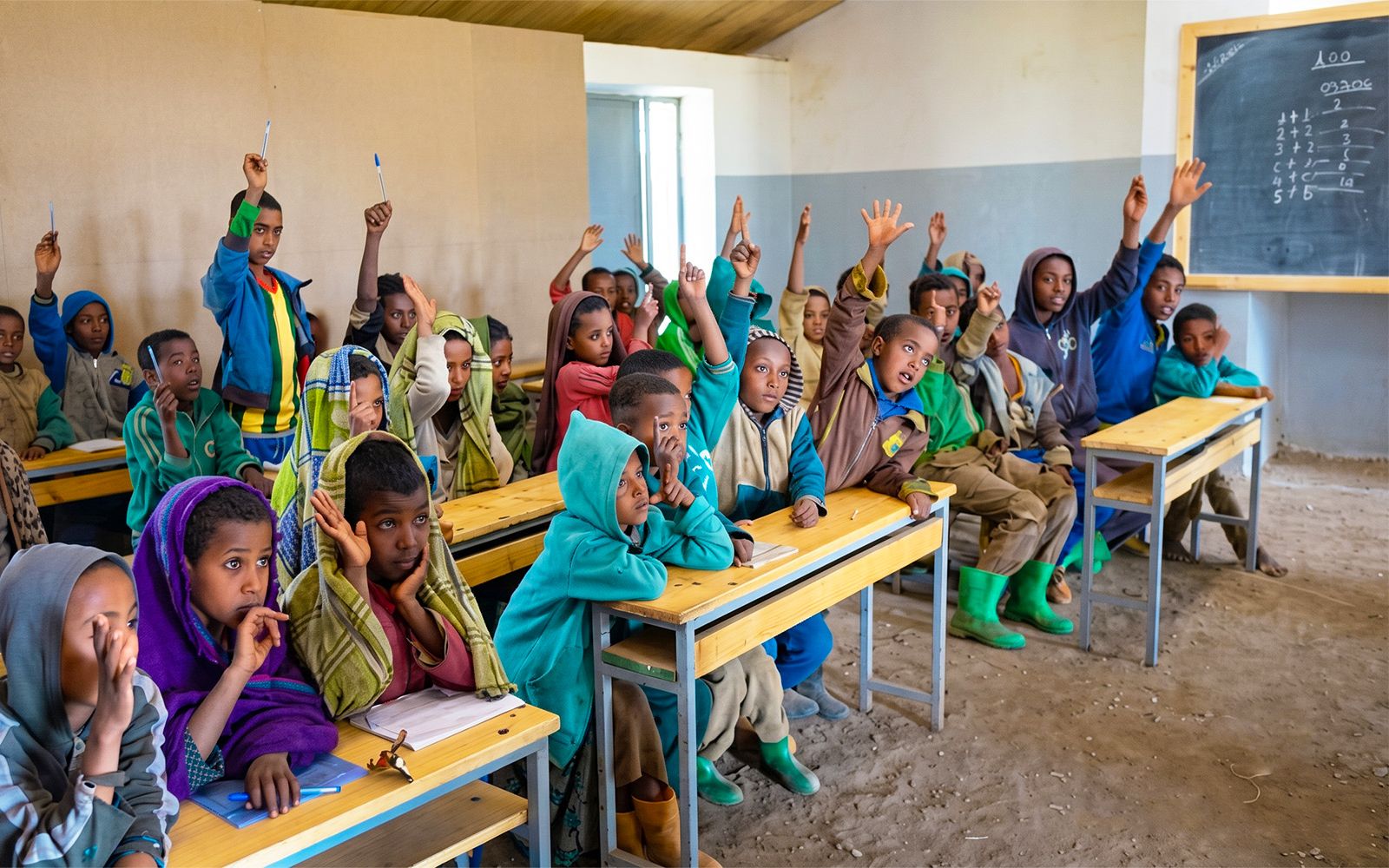
In a secondary school classroom in rural Amhara, a teacher with 60 students, one textbook between every four of them, and no broadband connection, is doing what teachers in that situation have always done: improvising. Writing exam questions from memory. Building lesson plans in the margins of a notebook. Covering a curriculum that was redesigned in 2022 with materials that arrived in 2025. The demand for something that helps has always been there. The Ministry of Education has now pilot-launched an Agentic AI Teacher Assistant that runs entirely offline on any computer, prepares lesson plans, generates exam questions aligned to the new curriculum, and organises teaching methodologies for Grades 9 through 12. It requires no internet connection. It requires no monthly subscription fee. It is built on the textbooks Ethiopian teachers are already supposed to be using.
The connectivity problem the application is designed around is not marginal. 79 percent of Ethiopian schools operate in environments without reliable internet access, and only 44 percent of Ethiopian households have access to electricity. Every AI-assisted education tool deployed in Ethiopia before this one — ChatGPT, Copilot, Gemini — has required both. The Ministry’s decision to build an offline-first application trained on the national curriculum and resident entirely on the device is not a technical workaround. It is a policy choice: to treat connectivity as an input that cannot be assumed rather than an infrastructure that will eventually arrive.
The quality gap the application is trying to close is equally documented. At the age of 12, approximately half of Ethiopian children fail to reach the low achievement benchmark for children aged 10, according to World Bank education assessments. Poor teacher quality is identified as a primary contributor — not because Ethiopian teachers lack dedication, but because teacher training programmes have not consistently addressed content knowledge gaps, and the admission pipeline into teaching has historically drawn from lower-performing graduates. An AI tool that generates a correctly structured lesson plan, aligned to the Grade 10 chemistry curriculum, for a teacher who is trained in a different subject, is not a replacement for better teacher training. It is a support that makes the teacher in front of the class more effective today, while the training pipeline catches up.
The application was developed based on Ethiopia’s new curriculum textbooks for Grades 9 through 12, revised under the 2021 education reform that restructured the grade-band system and reoriented secondary education toward competency outcomes. According to Dr. Zelalem Assefa, CEO of ICT and Digital Education at the Ministry, and Dr. Muluneh Atnafu, the department’s technical consultant, the tool is capable of preparing lesson plans, generating exam questions by topic and difficulty level, and organising teaching sequences across a term. Technical support for the development has been provided by the World Bank, which has been running teacher-focused AI pilots across Sub-Saharan Africa, including in Ethiopia, as part of a broader evidence-building programme on AI’s role in improving learning outcomes. Trial results in selected pilot schools have been described by the Ministry as highly satisfactory.
The no-subscription model matters as much as the offline capability. AI tools already available in Ethiopian schools — ChatGPT leads with 66.74 percent market share, followed by Microsoft Copilot at 16 percent — carry monthly or institutional costs that government secondary schools cannot absorb at scale. A tool that is built once, distributed on a USB drive or a local network, and requires no recurring payment has a marginal cost per teacher that approaches zero after initial deployment. GlobeDock Academy’s offline-first model, which has reached over 200,000 learners since 2023 without requiring internet access, demonstrates that the distribution mechanics for offline educational technology at a national scale already exist in Ethiopia. The Ministry’s application extends that logic to the teacher rather than the student.
The curriculum alignment is the tool’s most operationally significant feature. Ethiopia’s 2021 education reform introduced new Grade 9–12 textbooks across all subjects — books that many teachers received with limited training on how to teach from them. The Ministry partnered with UNESCO in May 2026 to draft a national AI policy for education, with the offline Teacher Assistant positioned as the practical delivery mechanism for AI integration in classrooms while the policy framework is being formalised. A teacher who opens the application and asks it to generate a lesson plan for Chapter 4 of the Grade 11 Biology textbook receives output calibrated to what the curriculum actually requires — not a generic response from a model trained on global internet text. That specificity is what makes the tool usable rather than merely impressive.
The pilot results are satisfactory. The offline architecture is sound. The no-subscription model makes national deployment economically viable. The World Bank’s own assessment of AI in African education is that teacher-focused tools, designed for local curriculum and deployable without reliable connectivity, represent the highest-impact intervention available at current cost levels. Ethiopia has built exactly that.