Ethiopia’s Sovereign Wealth Fund Commits $10 Million to Open Its Biggest State Companies to Local Startups
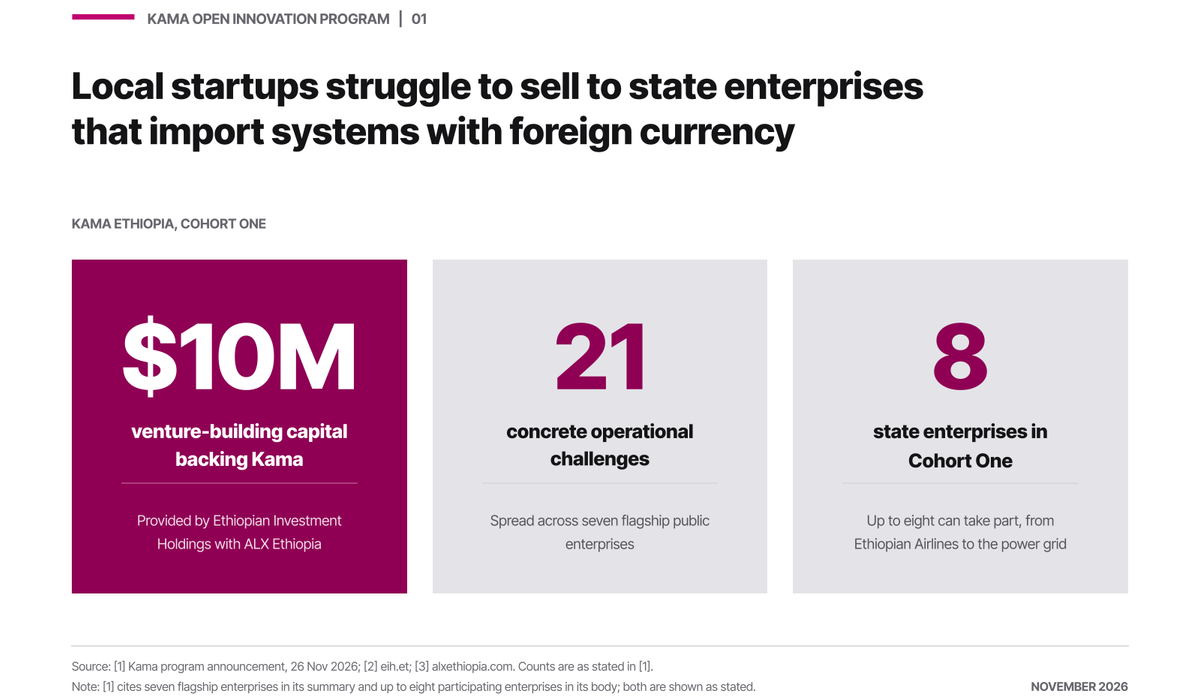
Co-launched by EIH & ALX Ethiopia, Kama pairs a 12-week pilot model with 21 operational challenges across 8 flagship public enterprises, from Ethiopian Airlines to the grid.
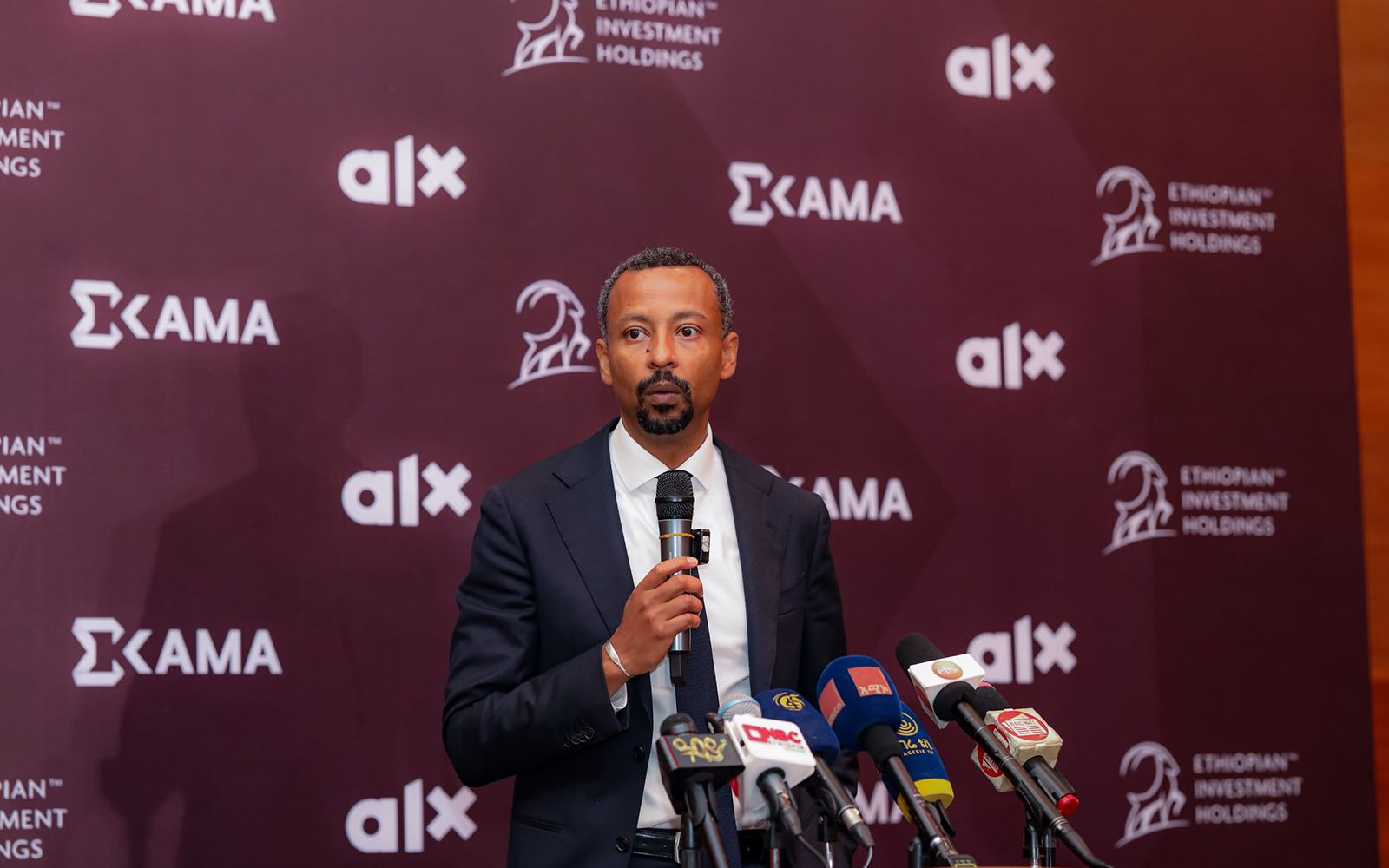
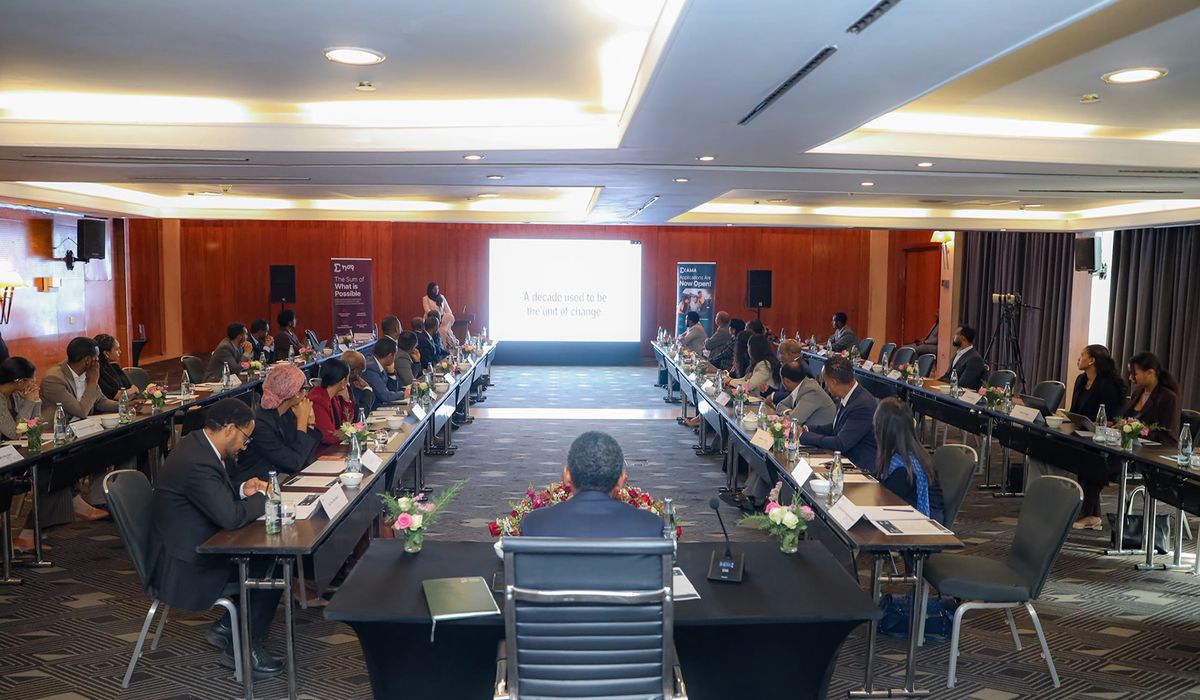
Across Africa, startups often struggle to sell software or engineering solutions to massive state-owned corporations, while those same public enterprises spend millions of dollars in scarce foreign currency importing off-the-shelf systems from abroad. To break that deadlock, Ethiopian Investment Holdings (EIH)—Ethiopia’s sovereign wealth fund overseeing the nation’s largest state-owned enterprises—has teamed up with pan-African tech accelerator ALX Ethiopia to launch Kama Ethiopia, a dedicated open-innovation and venture-building program backed by $10 million. Unveiled at the Hilton Hotel in Addis Ababa as Cohort One applications opened for up to eight participating state enterprises, Kama is designed to take promising Ethiopian innovations through four structured stages—from early testing and live operational pilots to full commercial rollout.
How Kama Works: A 12-Week "Proof Before You Buy" Model
Rather than relying on slow, traditional government procurement tenders that favor established foreign vendors, Kama flips the purchasing model so state corporations can test home-grown solutions inside real operations before signing a long-term contract:
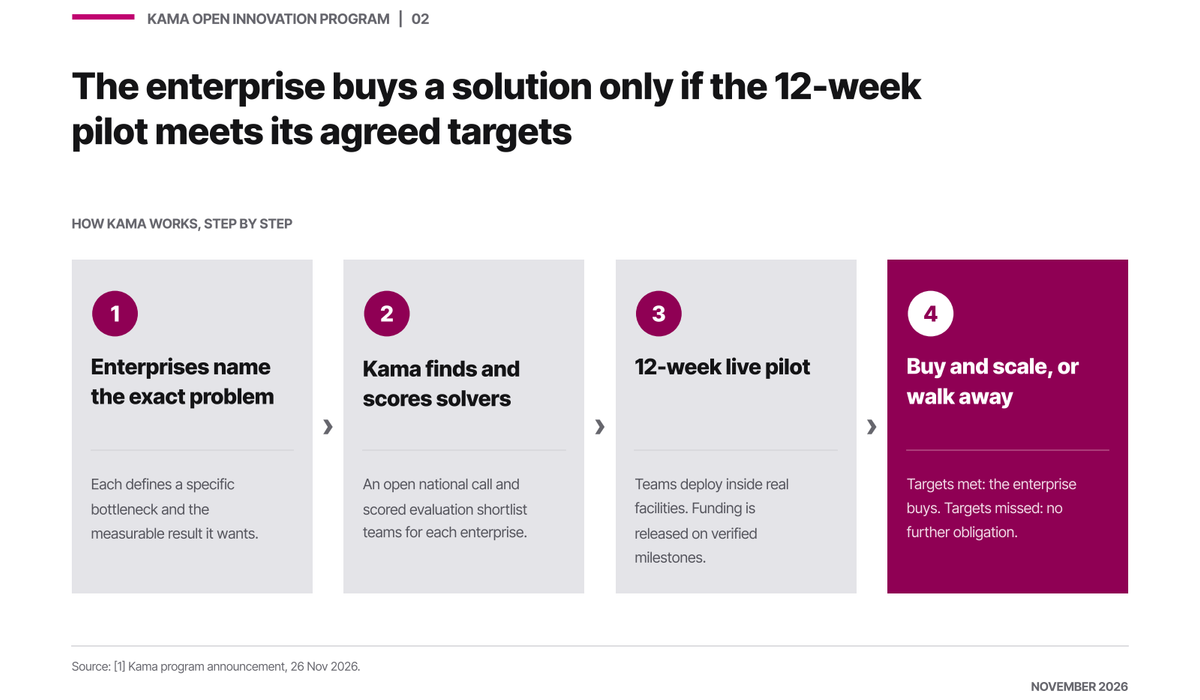
1. Enterprises Name the Exact Problem: Instead of vague innovation calls, state-owned companies define specific operational bottlenecks and the exact measurable results they want to see.
2. KAMA Finds and Scores the Solvers: Through an open national call and transparent, scored evaluation, Kama shortlists top Ethiopian startups, engineers, and venture teams for each enterprise to select.
3. A 12-Week Live Operational Pilot: Selected teams deploy their solution directly inside the enterprise’s real-world facilities for 12 weeks, with funding released strictly upon hitting verified milestones.
4. Commercial Adoption With Zero Obligation: If the pilot hits its agreed performance targets, the enterprise buys and scales the solution commercially; if it falls short, the enterprise walks away with no further obligation.
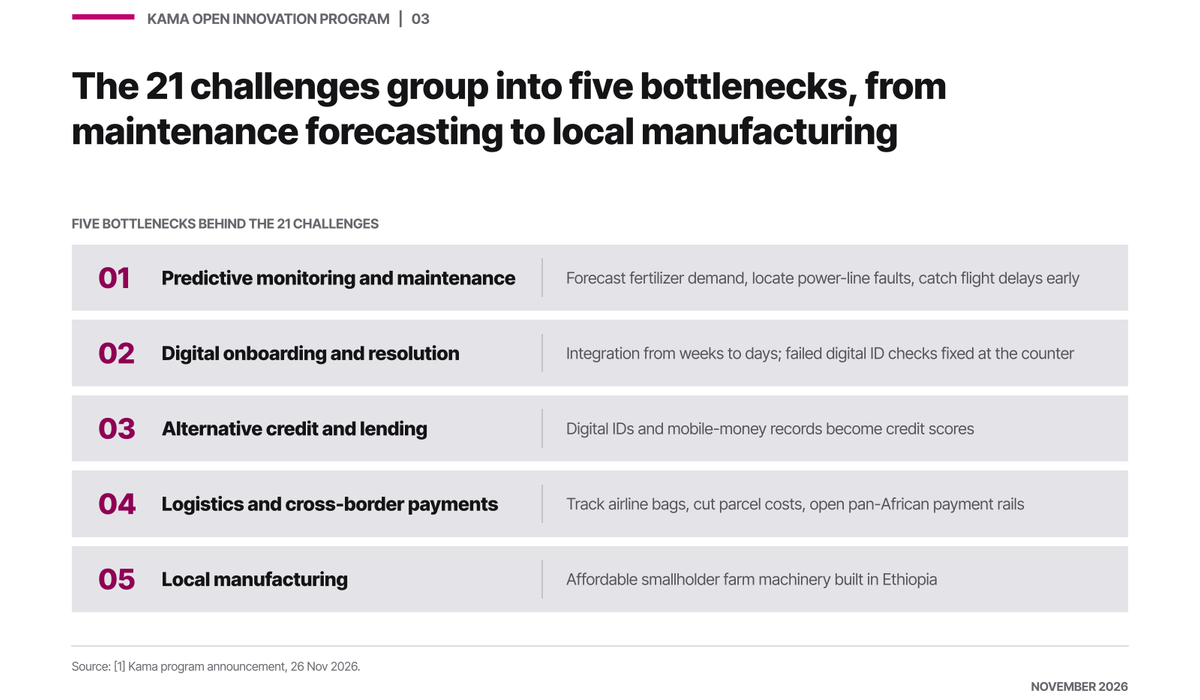
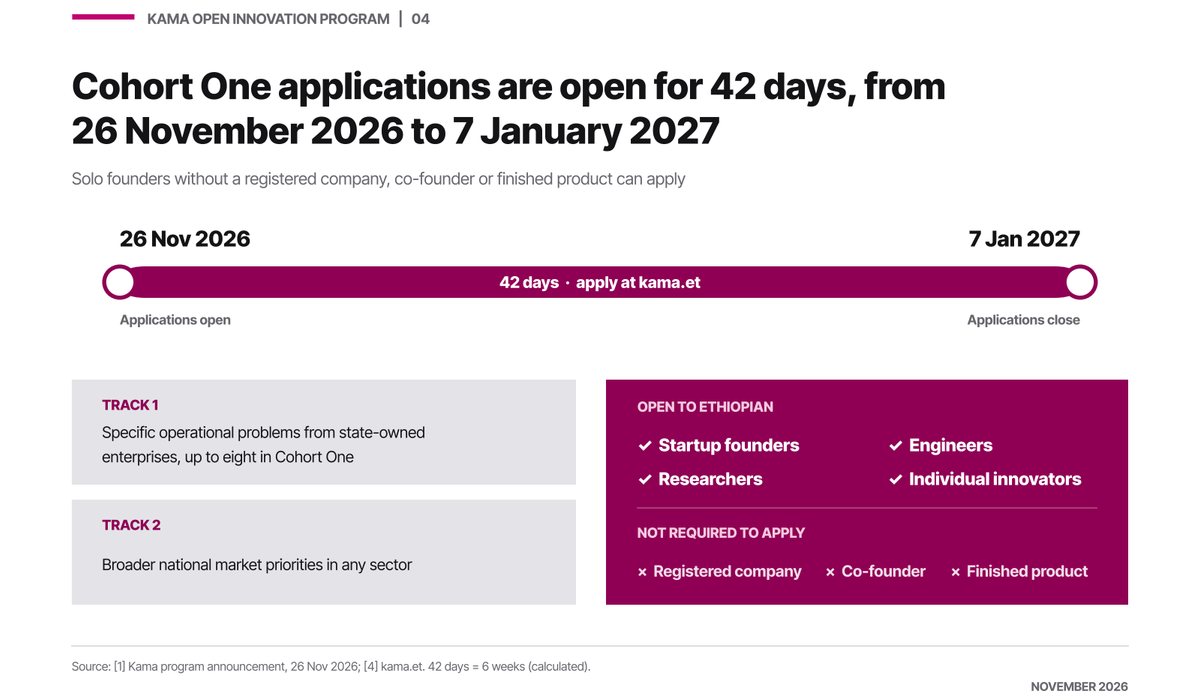
Across KAMA’s two-track program—which pairs specific operational problems from eight state-owned enterprises (Track 1) with broader national market priorities in any sector (Track 2)—the generic challenges boil down to five everyday bottlenecks holding back Ethiopia’s largest public institutions: predictive monitoring and maintenance (forecasting district fertilizer demand, locating power-line faults and overloaded transformers before burnout, and catching factory machine failures or flight delays early), faster digital onboarding and customer resolution (cutting institutional integration times from weeks to days and resolving failed digital ID checks right at the counter), alternative credit and faster lending (turning verified digital IDs and mobile-money repayment records into bankable credit scores while streamlining loan appraisals), seamless logistics and cross-border payments (tracking connecting airline bags, lowering international parcel shipping costs, and opening pan-African mobile-money payment rails), and local manufacturing (building affordable smallholder farm machinery at home). Applications for Cohort One opened on November 26, 2026, via kama.et and remain open until January 7, 2027, inviting Ethiopian startup founders, engineers, researchers, and individual innovators with scalable, technology-enabled solutions—even solo founders who do not yet have a registered company, a co-founder, or a finished product—to step forward and test their ideas inside a 12-week live operational pilot with a major public enterprise as their first customer.
For international investors and Ethiopia’s fast-growing tech community alike, Kama represents a major shift in how public infrastructure is modernized. By pairing $10 million in venture-building capital with guaranteed 12-week testing grounds inside billion-dollar state enterprises, Ethiopian Investment Holdings and ALX Ethiopia are turning the country’s toughest operational bottlenecks into a launchpad for scalable, home-grown technology companies.