
Addis Ababa’s Street Makeover Hits 1 Million Views in 24 Hours: Inside the Six-Route Upgrade Reshaping Ethiopia’s Capital
PM Abiy Ahmed’s aerial video showcased a 57-hectare urban project with tree-lined avenues, red bike tracks, 5,000-car parking, EV chargers & 3,100+ storefronts, drawing global attention.
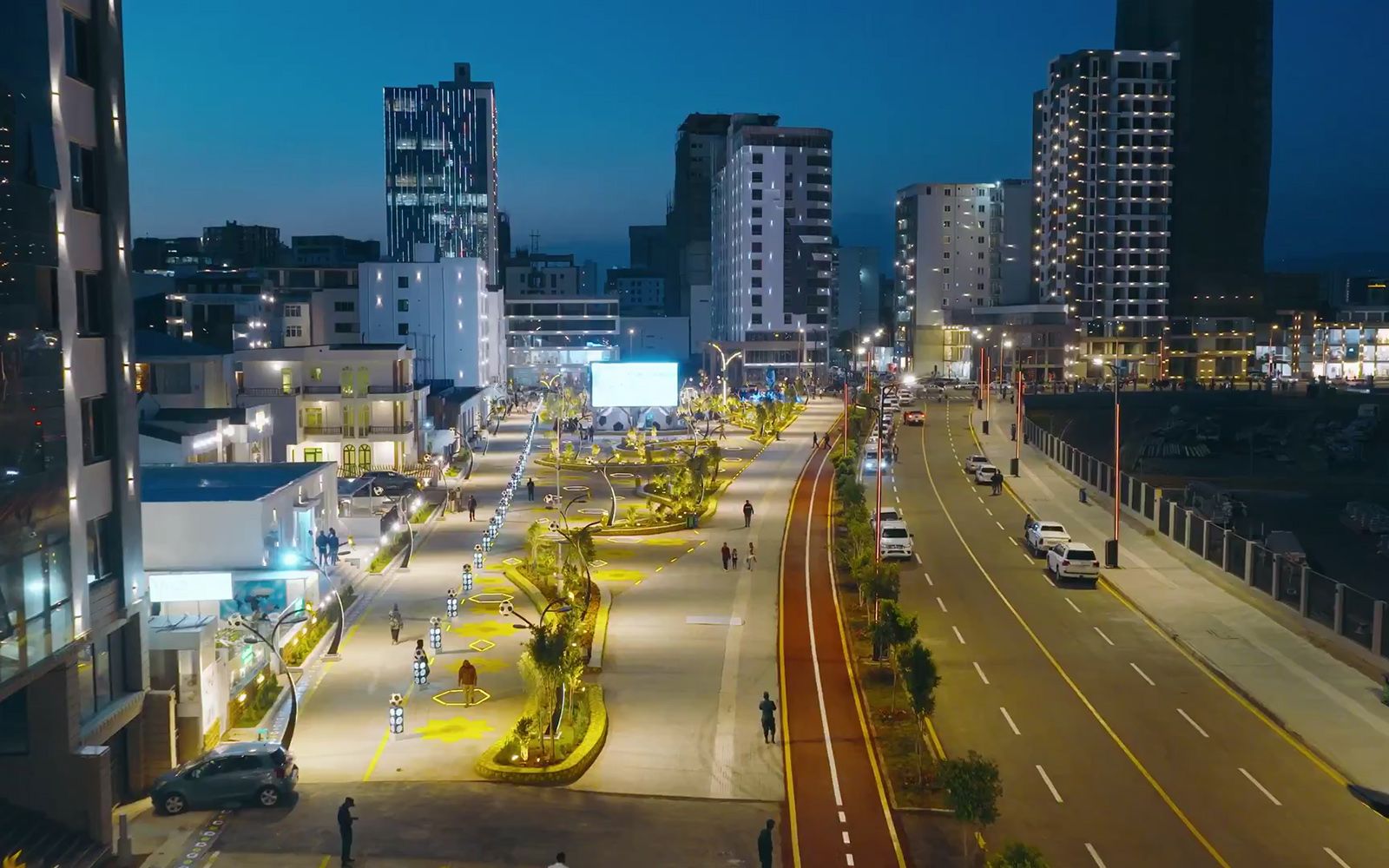
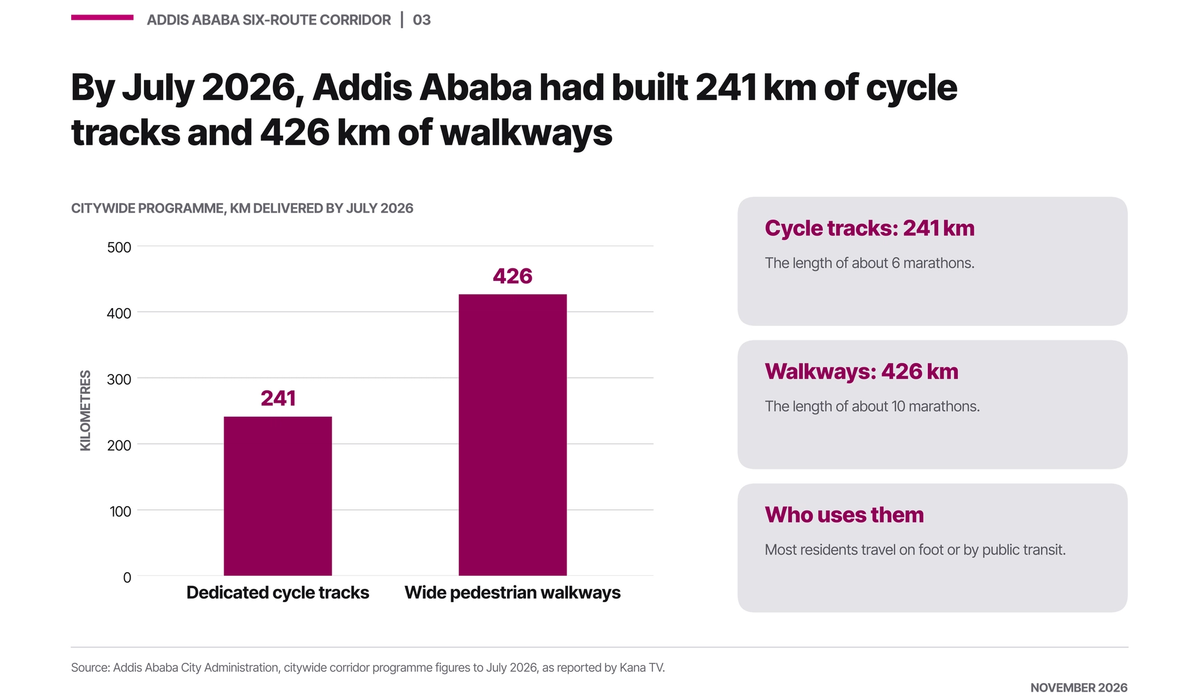
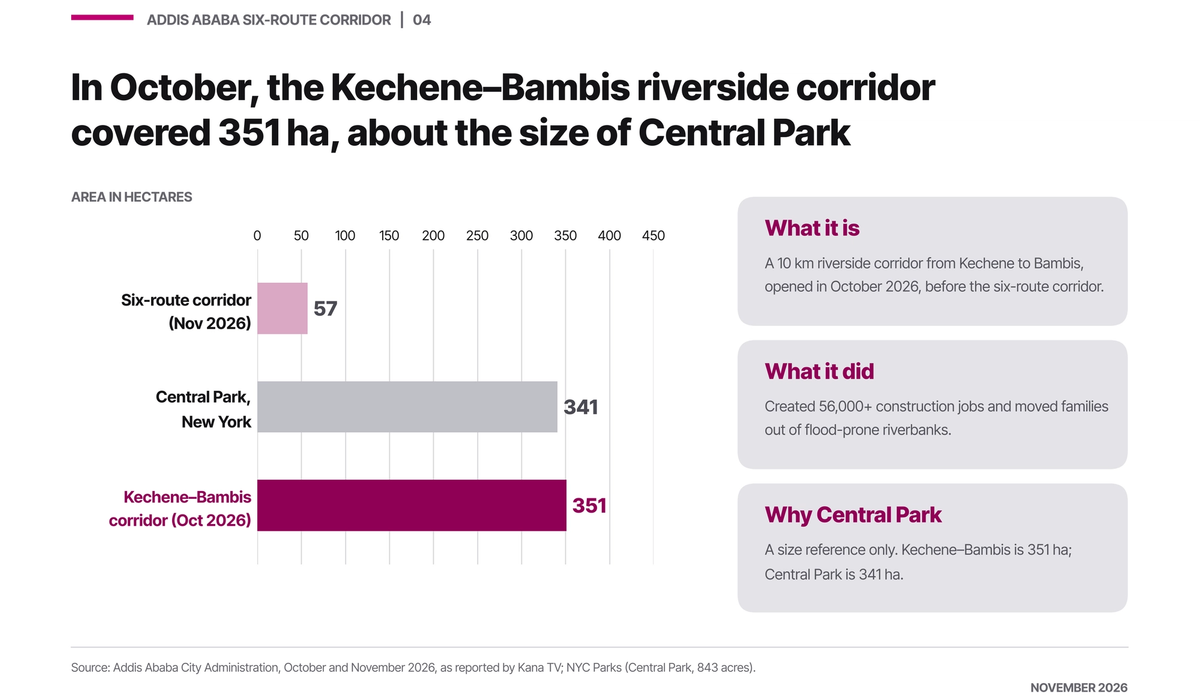
On Thursday morning, November 19, Ethiopian Prime Minister Abiy Ahmed posted a short aerial video on X showing sun-drenched, newly paved avenues in Addis Ababa lined with wide tiled sidewalks, red-paved bicycle tracks, green grass strips, and modern glass-and-steel commercial buildings, captioned “Building a cleaner, smarter, and more connected Addis Ababa for everyone.” Within just 24 hours, the clip crossed 1 million views—drawing more than 10,000 likes and 2,400 reposts—and sparking widespread attention from urban planners, diaspora communities, and international observers across Africa. The footage showcases a newly commissioned 57-hectare urban corridor development spanning six major routes across the Bole and central business districts—specifically Bole Medhanialem–Golagul–British Embassy, Bole Medhanialem–Moenco, Bole School–Adey Abeba Model Village, Imperial Hotel–Shalla Park, Chechnya–Bole Rwanda, and Adey Abeba Stadium–Bole Road—which was officially inaugurated on November 18.
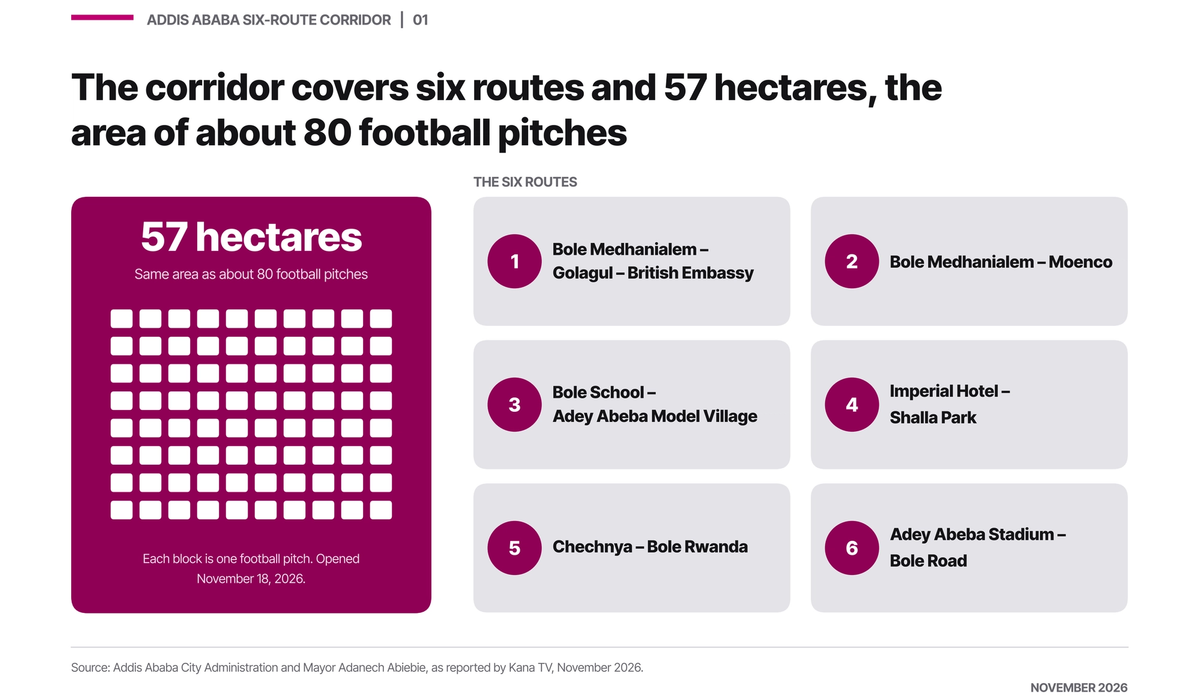
Behind the polished drone shots lies a comprehensive engineering overhaul aimed at fixing everyday bottlenecks in a capital city that generates nearly half of Ethiopia’s annual GDP. Rather than simply repaving asphalt, crews rebuilt the streetscape from underground up. Across the six routes, the project buried tangled overhead power and telecom cables into underground utility networks, installed electric vehicle (EV) charging stations, and built parking facilities for more than 5,000 vehicles to clear cars off congested curbs. According to Addis Ababa Mayor Adanech Abiebie, the redevelopment also renovated or newly constructed more than 3,118 shops and upgraded over 491 residential buildings, alongside refurbishing neighborhood schools, public libraries, playgrounds, sports fields, and green public plazas.
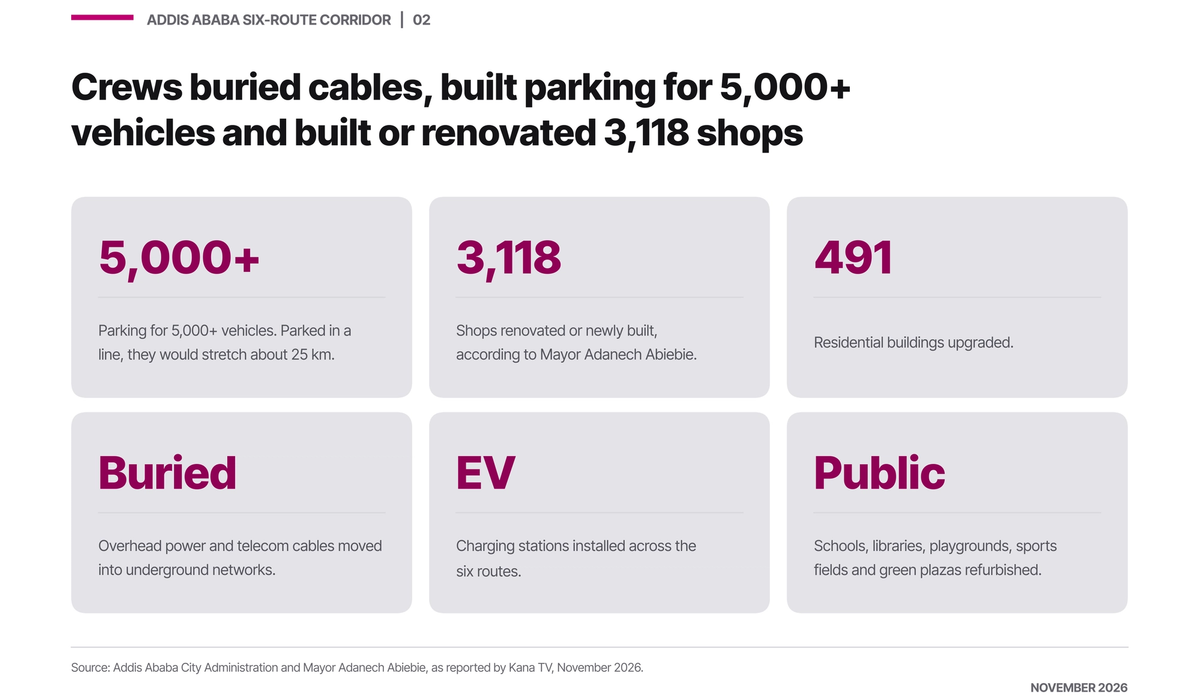
The viral six-route corridor is the latest piece of a rapid urban transformation that Ethiopia launched in 2024 and has since extended to 75 cities nationwide. By July 2026, Addis Ababa’s citywide program had already delivered more than 241 kilometers of dedicated cycle tracks and 426 kilometers of wide pedestrian walkways, fundamentally changing how residents walk and commute in a city where the vast majority of citizens travel on foot or by public transit. That momentum builds directly on recent milestones, including October’s 351-hectare, 10-kilometer Kechene-to-Bambis riverside corridor—which created over 56,000 construction jobs and moved families out of flood-prone riverbanks—and the ongoing 15-kilometer, eight-lane southern highway from Goro through Koye Feche to Tulu Dimtu.
For international onlookers, what stands out most about Ethiopia’s approach is its contrast with other African megaprojects. As Prime Minister Abiy has noted, while some countries have spent billions building brand-new administrative cities from scratch that remain largely empty, Addis Ababa is upgrading its dense, existing neighborhoods while communities and businesses remain in place.
At the same time, officials have been candid about the growing pains: the Prime Minister acknowledged after this week’s unveiling that several property owners had to make major adjustments to accommodate the wider streets, and noted that affordable housing, neighborhood feeder roads, and parking still require sustained work. Even so, as the viral video demonstrates, the physical transformation of Africa’s diplomatic capital is impossible to ignore—turning congested, wire-tangled streets into cleaner, walkable public spaces built for future generations.