
Ethiopia's MESOB, Which Now Delivers 130 Government Services From One Centre, Holds Its First Board Meeting
MESOB replaces hundreds of services that once meant multiple offices, long queues, and often informal payments. Its first board meeting just happened. The scale of the change is the story.
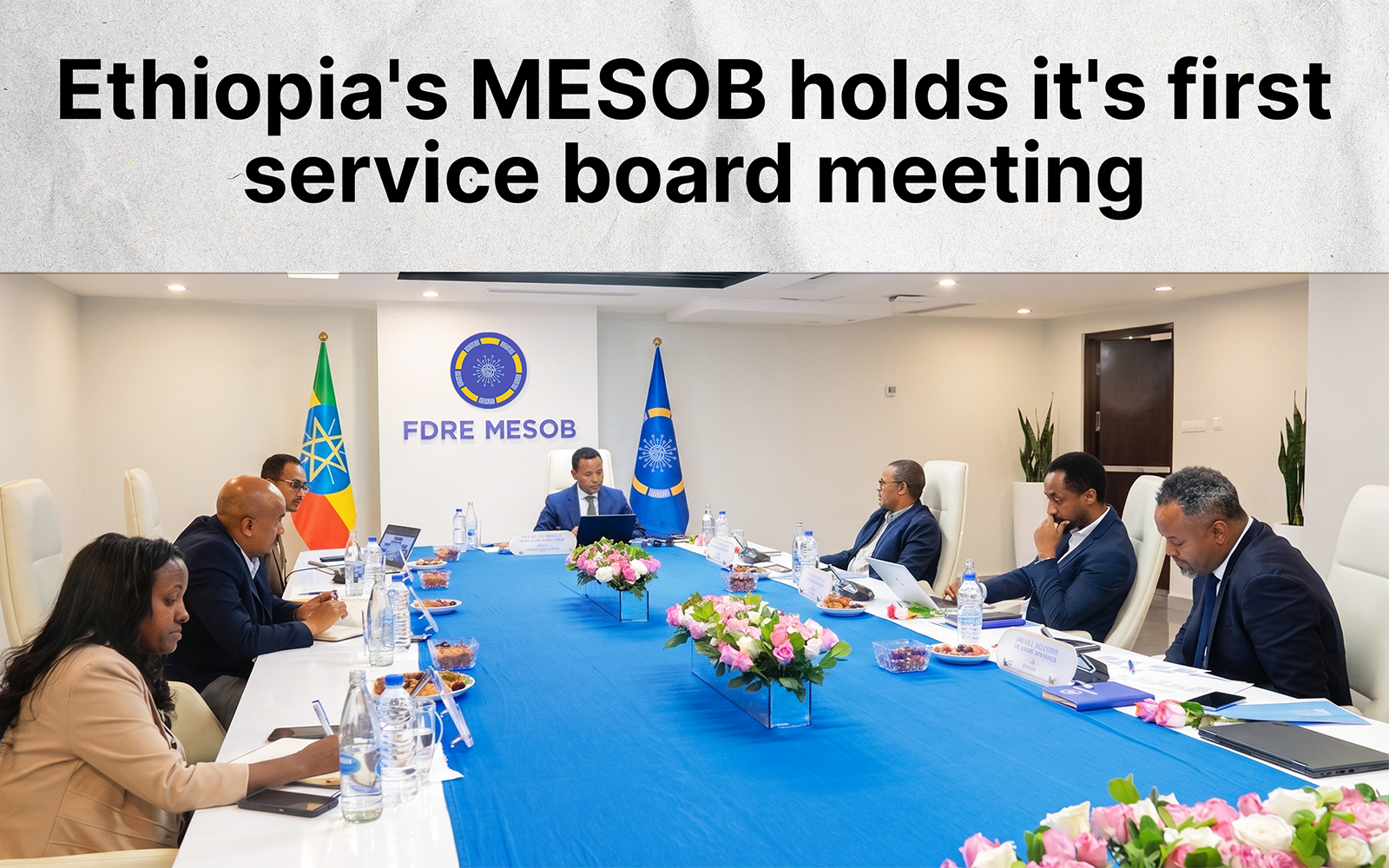
Getting a business licence in Addis Ababa used to require, on average, visits to multiple government offices, weeks of waiting, and a sequence of fees both official and unofficial that determined how fast the queue moved. MESOB — Modern Ethiopia Service for Organized Benefits — now delivers more than 130 government services under one roof, or through one app, authenticated by a Fayda national ID. The board that governs it held its first regular meeting on May 25, 2026. What that meeting represents, in practical terms, is the institutionalisation of a reform that Prime Minister Abiy Ahmed launched in April 2025 as a direct attack on one of the most deeply entrenched sources of friction in the Ethiopian economy: the bureaucracy that extractive corruption had made its home.
The model MESOB is built on is not Ethiopian in origin. A Memorandum of Understanding with Azerbaijan’s ASAN Service — which translates as “easy” — was signed in May 2024. ASAN is one of the most replicated anti-corruption service delivery models in the world: it works by removing the discretion of the individual civil servant entirely. When a service is delivered through a numbered ticket, a timed counter, a digital record, and a satisfaction survey, the informal payment has nowhere to land. The civil servant cannot delay, reroute, or withhold without it appearing in the data. MESOB uses a Bridge API Gateway to connect services and systems across participating agencies in real time, eliminating paperwork, reducing waiting times, and removing the need for multiple office visits. The architecture is the anti-corruption mechanism. The technology is the accountability layer.
The rollout has moved at speed. MESOB launched as a pilot in April 2025 with 12 government ministries and 41 services. In its first month, more than 12,000 people used the platform, with approximately 90 percent reporting satisfaction. By June 2025, the system had been rolled out nationwide. By March 2026, 36 physical service centres modelled on the ASAN design were operating across Ethiopia, with more than 200 planned by the end of the year. The centres include service desks, self-service zones, information points, and children’s corners — the physical design signalling that this is not a government office in the old sense but a service environment in which the citizen is a customer. The board appointed to govern it is chaired by the Director General of the Ethiopian Artificial Intelligence Institute and includes ministers of Finance, Labour, Planning, and Innovation, as well as the CEOs of Ethio Telecom and the Ethiopian Telecommunications Authority. The composition is deliberate: the people who built the digital infrastructure are the people accountable for its governance.
For the international reader, the reference point is Estonia — the country that digitised its entire public administration in the 1990s and is now consistently ranked among the least corrupt and most business-friendly environments in Europe. For the Ethiopian business operator, the reference point is simpler: Deputy Prime Minister Temesgen Tiruneh, visiting the MESOB centre in May 2025, described it as directly contributing to economic growth and a more favourable investment climate by reducing bureaucracy, combating corruption, and improving efficiency. The IMF’s fifth review of Ethiopia’s Extended Credit Facility — signed the same week as MESOB’s board meeting — specifically identifies institutional reform and governance improvement as conditions for continued disbursement. MESOB is not peripheral to Ethiopia’s macroeconomic reform programme. It is structural to it. The $468 million unlocked by the fifth review flows into an economy that is, demonstrably, building the institutional infrastructure that foreign investors and multilateral lenders require as a precondition for scaled capital.
The first board meeting of MESOB is not a headline event. It is an operational milestone — the moment a pilot becomes a permanent institution with a governance structure, a legal mandate, and named accountability. The draft regulation establishing MESOB as an autonomous federal office nested under the Civil Service Commission has been tabled before the Council of Ministers. When it passes, MESOB will have the legal architecture to enforce compliance not just on government ministries but on third-party contractors and public enterprises. The bribe that used to sit in the gap between the citizen and the certificate will, by design, have no gap left to occupy. Whether 200 centres by the end of 2026 become 500 by 2028, and whether the API gateway extends to land registration, tax filing, and import licensing — the three highest-corruption-risk interactions in the Ethiopian economy — is the measure by which this reform will ultimately be judged.