
Why the Upstream Nile States Keep Voting the Same Way
Ethiopia, Tanzania, Uganda, Rwanda, Burundi and South Sudan Ratified the Nile Basin Cooperative Framework Agreement Between 2013 and 2024
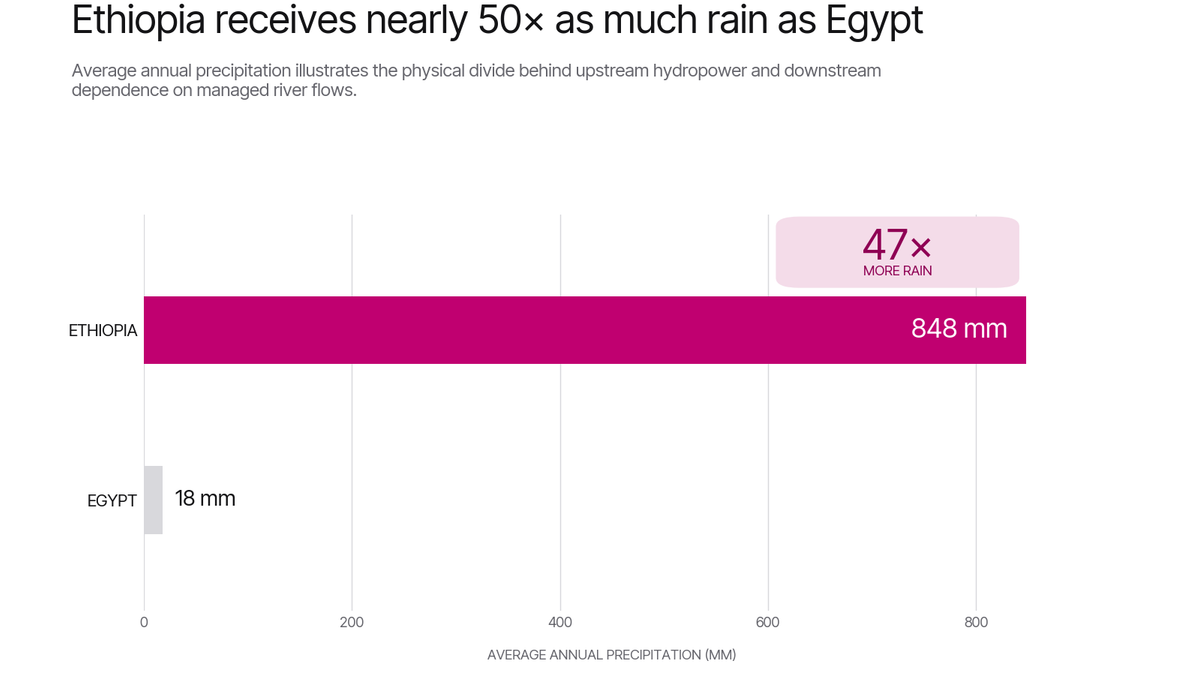
The Nile's eleven riparian states split into two blocs by geography before they split by politics. Ethiopia's highlands get 848mm of rain a year against Egypt's 18mm, which is the physical reason hydro power sits upstream and irrigated farmland sits downstream. Eleven countries share the basin, combining for roughly 400 million people, a figure the UN expects to double by 2050. That's the raw material for one integrated market — power traded for food, grids linked border to border. Whether it becomes that or stays two competing camps is being decided now, largely on paper, in a treaty most people outside the region have never heard of.
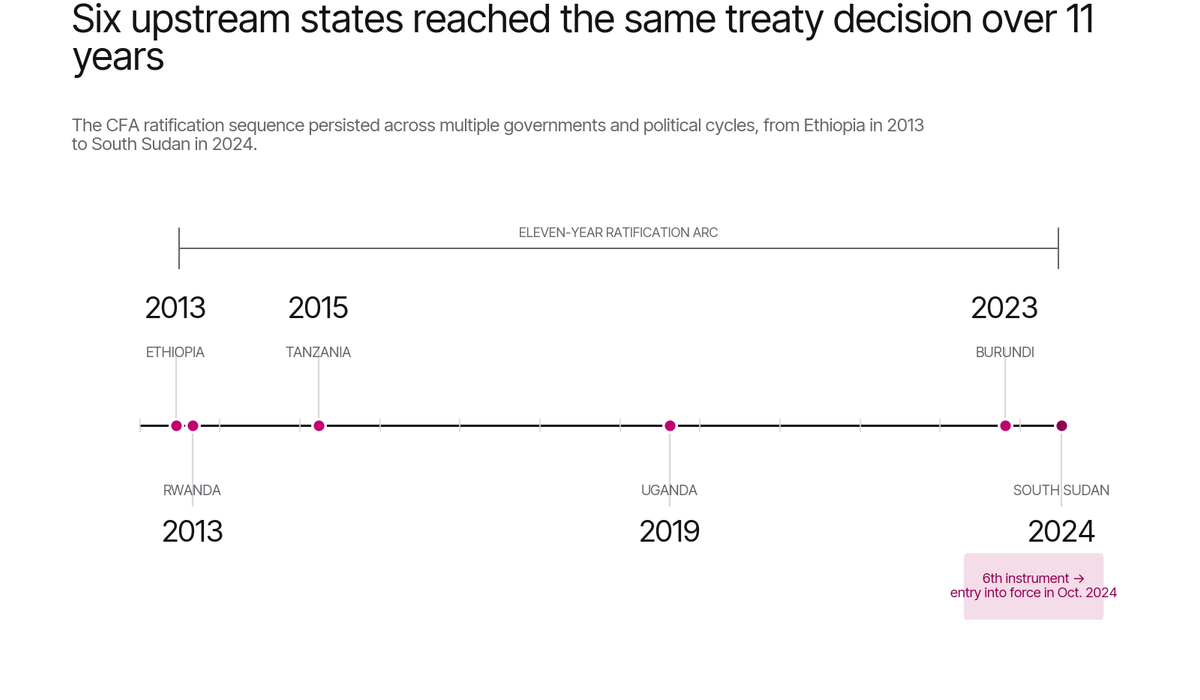
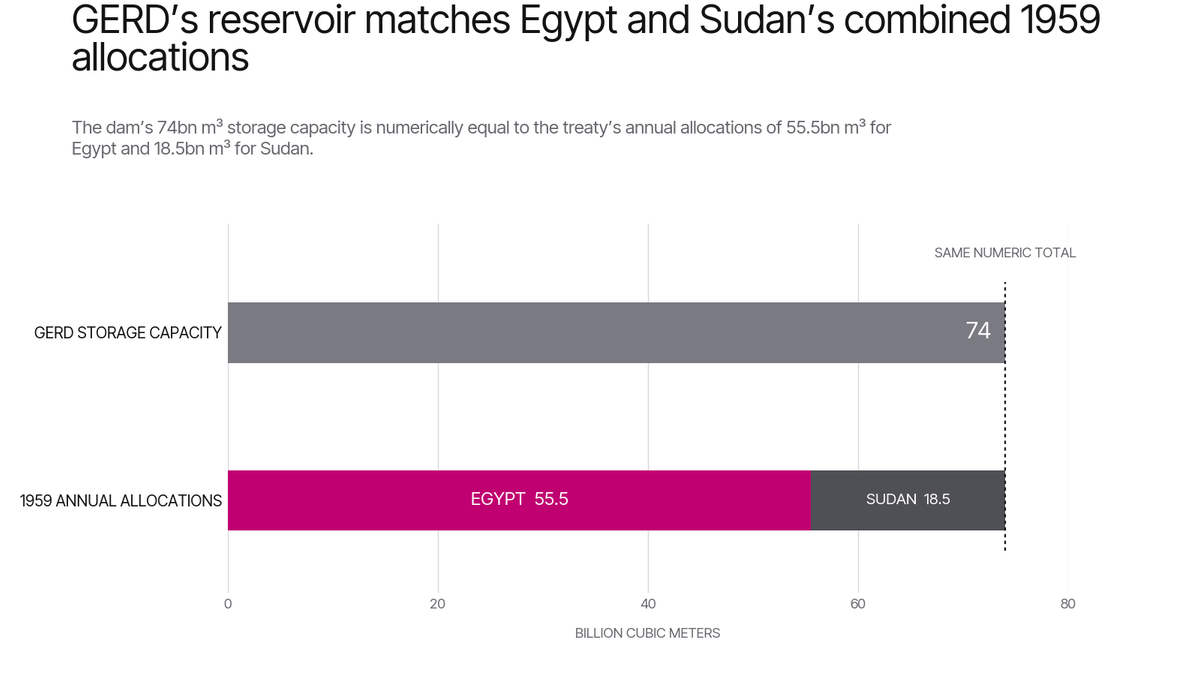
That treaty is the Nile Basin Cooperative Framework Agreement, negotiated over more than a decade and signed at Entebbe in 2010. Four upstream states — Ethiopia, Tanzania, Uganda and Rwanda — signed it the day it opened. Kenya and Burundi followed within months. Ratification took longer: Ethiopia ratified in 2013, Rwanda the same year, Tanzania in 2015, Uganda in 2019, Burundi in 2023, and South Sudan in July 2024, which triggered entry into force that October. Six countries, spread across fourteen years of domestic politics, coup risk, civil war and leadership turnover, arrived at the same ratification decision. Egypt and Sudan, the two downstream signatories to the 1959 agreement that allocated 55.5 billion cubic meters to Egypt and 18.5 billion to Sudan without consulting anyone upstream, have both rejected the new framework. That's not a coincidence of timing. It's six governments with limited overlap in language, religion, colonial history or current alignment landing on the same conclusion about a shared resource, while the two states benefiting from the older arrangement declined to sign either version.
The mechanism behind that consistency isn't sentiment. An upstream state acting alone against Egypt's preferences risks retaliation calibrated to that state individually — a trade dispute, a diplomatic freeze, a competing bilateral offer. An upstream bloc acting together raises the cost of retaliation across six or seven capitals simultaneously, which is a materially different calculation for whoever is doing the isolating. Ethiopia's position inside that bloc is set by volume, not by diplomacy: it supplies roughly 85% of the Nile's total flow through the Blue Nile alone, which makes it the largest single stake in any basin-wide arrangement and the state whose defection or entrenchment moves the bloc's weight the most. A framework that works for the upstream states without Ethiopia's ratification is a framework without teeth; a framework Ethiopia has already ratified and is pushing to implement in full, as it did again in August 2025 ahead of the GERD inauguration, is one the rest of the bloc has reason to hold onto.
The interlocking part of this isn't only legal text. It shows up in infrastructure and in emergencies that have nothing to do with water. When Sudan's civil war broke out in 2023, Tanzanian nationals trapped in Khartoum were moved out through Ethiopia — buses to the border town of Metemma, transfer to Gondar, an airlift to Addis Ababa, then an Air Tanzania flight home. Ethiopian peacekeepers and airlift capacity have rotated through Darfur, South Sudan, Somalia and the Great Lakes region for two decades, independent of any Nile negotiation. None of that is water diplomacy on its face, but it is the kind of standing capacity — airspace, logistics, troop-contribution relationships — that makes a Tanzania or a Uganda more expensive to peel away from Addis Ababa than a single dam dispute would suggest, because the relationship being severed is broader than the dam.
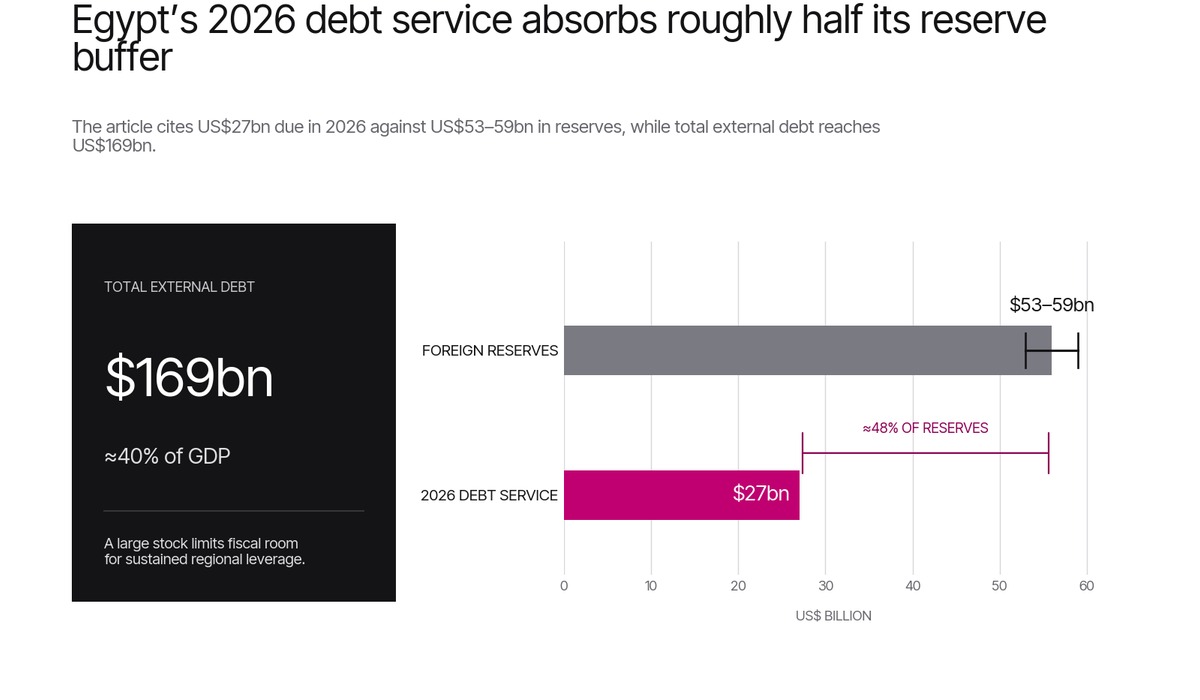
Detaching one upstream state from that arrangement requires a competing patron with comparable resources and, in practice, some leverage over the target state's internal politics — enough to redirect a government's attention inward rather than toward regional coordination. Egypt is the state with the clearest incentive to play that role, and also the state currently least equipped to fund it. Egypt's external debt reached $169 billion, about 40% of GDP, with $27 billion in external debt service due in 2026 alone and reserves of roughly $53–59 billion — five months of import cover, by the IMF's own framing. Interest payments alone account for more than half of total government expenditure in the 2026 budget. Egypt is currently the IMF's fifth-largest exposure under an $8 billion Extended Fund Facility, with outstanding credit expected to rise again through the end of 2026 even as the government reports inflation down from a 2023 peak near 40% to 12.3% in November 2025. Short-term portfolio outflows tied to Egypt's high-interest local debt have run to more than $40 billion since 2022 — over four times peak Suez Canal revenue — meaning a meaningful share of Egypt's macro stability currently rests on foreign holders of local-currency debt staying in, not on export earnings. That is not the balance sheet of a state with much room to bankroll a long-term diplomatic campaign to fracture a six-country bloc.
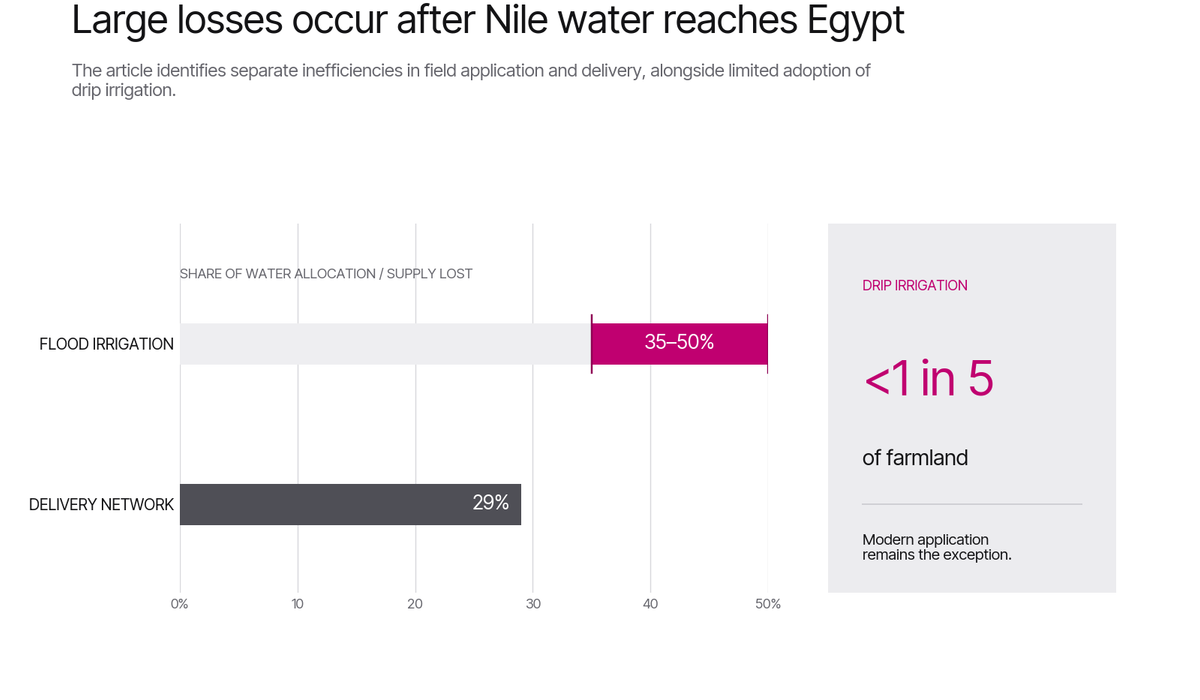
Egypt's water position compounds the same constraint rather than offsetting it. Egypt draws 97–98% of its renewable water from the Nile, the fact underneath every Egyptian statement on the dam. But measured against its upstream neighbors, Egypt isn't short of water — it will be short if it does not correct what happens to the water once it arrives. Government estimates put losses from outdated flood irrigation at 35–50% of the water allocated to agriculture, with drip irrigation covering under a fifth of farmland, and the delivery network separately losing about 29% of total supply to leakage and evaporation across 29,000km of canals. Put plainly: of every three units of water that reach Egyptian farmland, roughly one never reaches a crop. That's a function of flat delta geography, near-zero rainfall and decades of subsidized water pricing that gave farmers no incentive to switch systems — not a function of the volume Ethiopia releases upstream.
That inefficiency is why a drought upstream has historically translated directly into an Egyptian crisis rather than a manageable dip — there was no buffer beyond the Aswan High Dam, and Aswan itself was losing storage capacity to silt. The GERD, financed entirely by Ethiopia without a foreign loan, changes that arithmetic mechanically. It holds 74 billion cubic meters, enough to regulate flow to Aswan through a dry year instead of Egypt absorbing the shortfall directly, and it intercepts the sediment that has been accumulating in Lake Nasser for six decades. Egyptian and international modeling puts the projected reduction in sediment reaching Aswan at up to 90% by 2060 compared with a no-dam scenario — a direct extension of Aswan's working reservoir life, documented in the same literature Cairo cites when it argues the dam's filling schedule was unilateral.
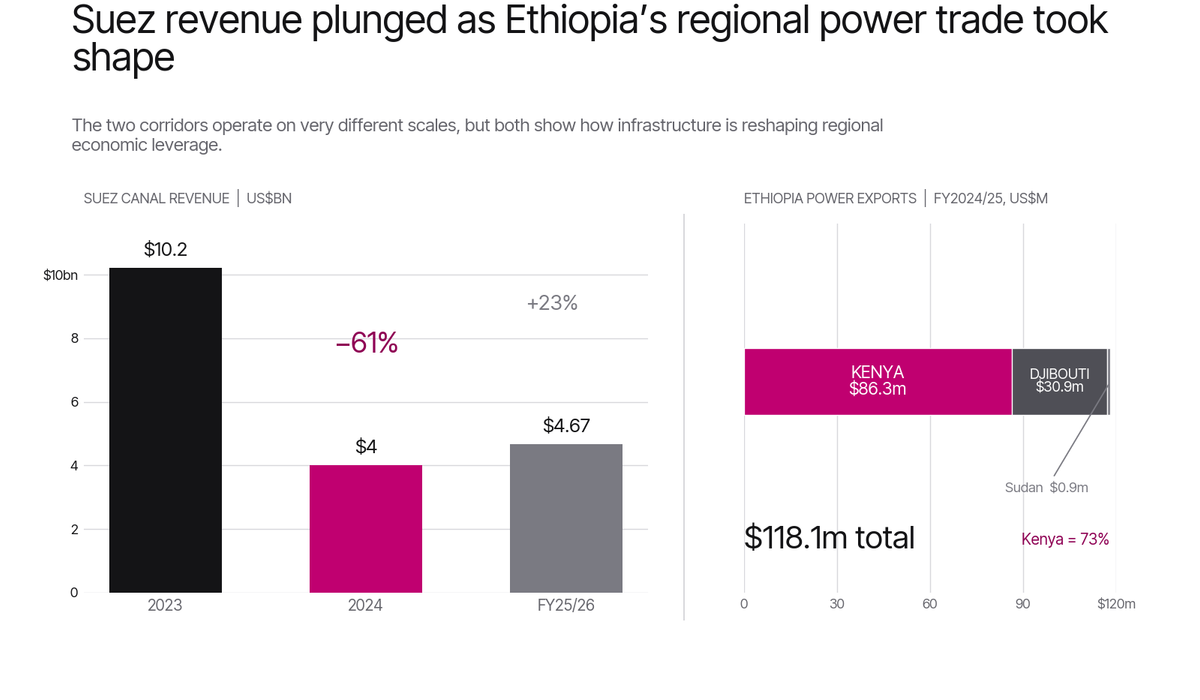
The dam's second function, regional electricity, is arriving at the same moment the region's other energy corridor has gotten measurably less reliable. Ethiopia earned $118 million from power exports to Kenya, Djibouti and Sudan in the last fiscal year — Kenya alone worth $86 million — with transmission expanding toward Tanzania and South Sudan.
That revenue exists because the alternative, fuel imports routed past a Red Sea corridor still recovering from Houthi disruption, got structurally more expensive over the same two years GERD came fully online. Egypt's own hard-currency exposure to that corridor is the clearest illustration: Suez Canal revenue fell from $10.3 billion in 2023 to under $4 billion in 2024, a loss Cairo priced at roughly $800 million a month at its worst, before recovering 23% in the most recent fiscal year while remaining below 2023 levels.
Two separate corridors — one carrying water, one carrying ships — are both running through the same set of geopolitical bottlenecks, and both are currently favoring the side that finished building its own reservoir before the crisis hit.